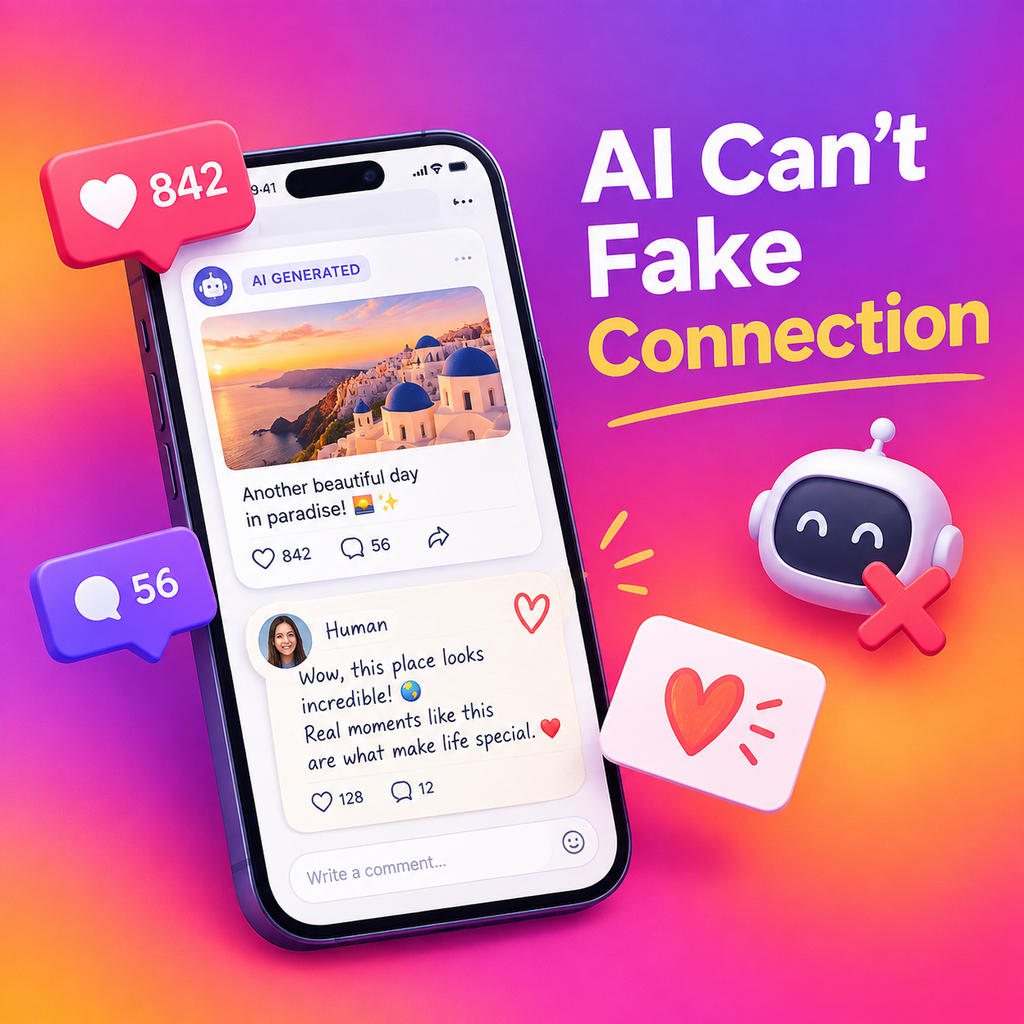
The Cost of Automating Authenticity: A.I.’s Limits in Social Media
The Efficiency Trap: When A.I. Content Backfires
Social media teams are under immense pressure to produce more content, faster. A.I. tools promise to solve this by automating everything from ideation to scheduling. But a growing body of research reveals a troubling trade-off: while A.I. can boost output, it often erodes the very authenticity that makes social media effective. Audiences are increasingly savvy, quickly labeling generic A.I. output as “slop.” The result? Brands may gain volume but lose the human connection that drives loyalty and trust.
Consider the data: a 2026 study in Scientific Reports found that while A.I. assistance increased engagement and content volume, it simultaneously decreased perceived quality and authenticity. Participants rated A.I.-assisted comments as less informative and lower quality than human-written ones. Worse, the introduction of A.I. content into a thread had a negative spillover effect, degrading subsequent human conversation. This suggests that A.I. doesn’t just fail to connect—it can actively damage the conversational environment.
The Illusion of Connection: Why A.I. Can’t Fake Human Bonding
At its core, social media is about people connecting with people. The Observer notes that people log into social networks to hear from other humans. A.I. can generate a post, but it can’t understand the nuanced context, humor, or emotional resonance that makes a message stick. It lacks taste and human insight—two crucial ingredients for authentic engagement. As one expert put it, “A.I. can produce a post, but it can’t tell you if that post is good.”
This limitation becomes glaring when brands rely solely on A.I. for content creation. Without a human editor or strategist, A.I. churns out repetitive, uninspired content that audiences quickly ignore. The Deloitte insights highlight that while generative A.I. can bring ideas to life quickly, relying on it completely undermines differentiation and authenticity. In a sea of synthetic sameness, human creativity becomes the ultimate differentiator.
The Rise of Synthetic Influencers and the Trust Deficit
The latest frontier in A.I. content is the synthetic influencer—a completely virtual persona that posts, engages, and even endorses products. These A.I.-generated creators are becoming harder to distinguish from real humans. A 2025 report found that new A.I. personas can look like ordinary users, follow trends, and build sizable followings. But while they may attract eyeballs, they struggle to build genuine trust. After all, audiences want to believe there’s a real person behind the account.
This trust deficit is compounded by the rise of mass-produced A.I. content. A June 2026 investigation by Kapwing analyzed over 10,000 TikTok videos and found that 59% of videos served to a new account’s For You page were classified as “A.I. slop.” This content is created quickly and at scale, with the primary goal of racking up views rather than offering value. Platforms are responding: Meta announced it would prioritize original content in feeds and reduce the reach of unoriginal material. The message is clear: authenticity is becoming a platform-level priority.
The Human Element: Judgment, Taste, and the Art of Timing
A.I. excels at pattern recognition and speed, but it falters when it comes to judgment and timing. Social media success often hinges on knowing when to post, how to respond to a crisis, or which cultural moment to leverage. These decisions require human intuition and emotional intelligence. As the Observer points out, A.I. can’t predict how your audience will feel about an image or whether the tone will resonate or alienate. But a skilled social media team can.
Moreover, humans bring a level of creativity that A.I. can only mimic. The Deloitte report notes that generative A.I. can help bring ideas to life quickly, but it’s the human touch that makes content distinctive. Brands that use A.I. as a tool—not a replacement—for human creativity can achieve both efficiency and authenticity. The key is to let A.I. handle repetitive tasks while humans focus on strategy, storytelling, and community engagement.
Disclosure and Transparency: The New Currency of Trust
As A.I. content becomes more prevalent, transparency is non-negotiable. A 2026 study in Scientific Reports recommends transparent disclosure of A.I.-generated content paired with user autonomy. Audiences want to know when they’re interacting with A.I., and they value the ability to choose. Brands that fail to disclose A.I. use risk eroding trust and facing backlash. The Business Standard reports that 85% of industry experts say audience expectations around A.I. disclosure are increasing or staying the same.
But disclosure alone isn’t enough. Context matters: consumers need to understand whether A.I. was used for minor tasks like background noise removal or for creating an entire persona. The latter is far more likely to trigger skepticism. Platforms are also stepping up, with tools to detect and label A.I. content. For brands, the takeaway is simple: be transparent, be specific, and always put the human element first.
The Path Forward: Amplifying Humanity with A.I.
The future of social media isn’t A.I. versus humans—it’s A.I. serving human expertise. As the Observer succinctly puts it, “A.I. should serve human expertise, not replace it.” The most successful brands will use A.I. to streamline workflows, generate ideas, and analyze data, while reserving the creative and strategic decisions for humans. This hybrid approach allows for scale without sacrificing authenticity.
Innovative brands are already experimenting with this balance. They use A.I. to draft posts but have human editors refine them. They employ A.I. chatbots for customer service but escalate complex issues to humans. They leverage A.I. for content calendars but rely on human intuition for real-time engagement. The result is a more efficient operation that still feels personal. As the research shows, no single A.I. tool enhances both producer and consumer experiences—but a thoughtful combination of A.I. and human talent can.
Ultimately, the cost of automating authenticity is too high. Audiences crave connection, and connection requires a human touch. In a world of increasing synthetic content, the brands that stand out will be those that double down on what makes us human: creativity, empathy, and the ability to truly connect.