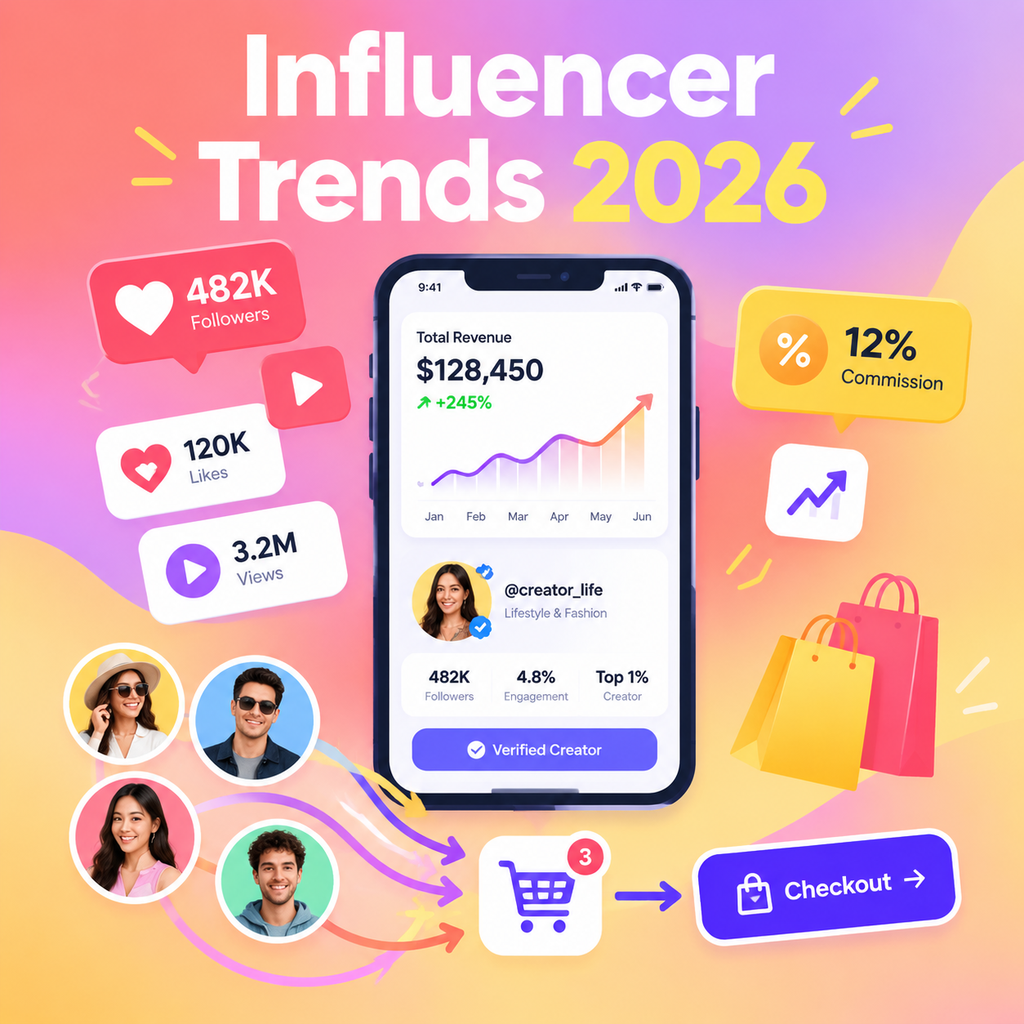
Influencer Trends That Are Driving Marketing Success in 2026
From Vanity Metrics to Verified Revenue
The influencer marketing landscape has undergone a seismic shift. Gone are the days when a million likes signaled a job well done. In 2026, brands are demanding proof that creators move the needle on the bottom line. According to industry surveys, 74% of brands are moving budget into creator programs—not as side experiments, but as core commercial engines. This isn't about chasing viral moments anymore; it's about building a measurable, scalable revenue channel that earns its place alongside paid search and email. The era of influencer marketing as a branding luxury is over. Performance accountability is now the price of entry, and the creators who can demonstrate real business impact are the ones commanding premium partnerships.
The Full-Funnel Performance Revolution
For years, influencer campaigns were evaluated on reach and engagement—metrics that looked good in a deck but rarely translated to sales. That’s changing fast. The defining trend of 2026 is the industry’s break from vanity metrics. Brands are now layering in incrementality testing, lift studies, and blended attribution models to understand a creator’s true contribution across the entire customer journey. As Alison Rinaldi, VP of Affiliate Marketing at Assembly Global, puts it: “Influencer 2.0 is here: creators are no longer just content partners, they’re commerce partners.”
This shift means influencer programs are planned with the same rigor as any other performance channel. Defined KPIs, structured testing, and budget tied to outcomes are now standard. The question is no longer “how many people saw this?” but “how many people bought because of this?”
Hybrid Compensation Takes Center Stage
Flat fees are fading. Brands are transitioning to hybrid deals that blend a guaranteed base with a transparent 10–15% commission and unlockable bonus tiers tied to performance. This model aligns incentives perfectly: creators are paid for creativity and conversions, while brands get predictable costs and scalable returns.
Micro and Nano Creators: The Secret Weapon
Big names no longer guarantee big results. In fact, micro-influencers (10K–100K followers) and nano-influencers (under 10K) consistently outperform their larger counterparts on engagement, cost-efficiency, and conversion. These creators have tighter communities, higher trust, and audiences that actually act. What’s changed in 2026 is how brands activate them—not as one-off collaborators, but as part of structured creator portfolios.
Instead of betting the budget on one celebrity post, brands are building fleets of niche creators who speak directly to specific segments. This approach not only lowers risk but also generates a steady stream of authentic content that can be repurposed across paid, owned, and earned channels. The math is simple: a hundred engaged micro-creators will almost always outperform a single mega-influencer when it comes to driving sales and building lasting brand affinity.
Long-Term Partnerships Beat One-Off Posts
The days of transactional influencer posts are numbered. Brands are seeing 70% higher engagement when they invest in sustained creator partnerships rather than one-off campaigns. Why? Because trust compounds. When a creator mentions a brand repeatedly over months, their audience internalizes the recommendation. It stops feeling like an ad and starts feeling like a genuine endorsement.
Algorithmic platforms also reward consistency. Repeated collaborations generate more content, more data, and more opportunities to optimize. Creators, meanwhile, benefit from predictable income and deeper creative alignment. It’s a virtuous cycle that pushes both parties to invest more in the relationship. The smartest brands are now signing creators to long-term deals that include content licensing, exclusivity windows, and performance benchmarks—treating them as true extensions of the marketing team.
Authenticity Is Non-Negotiable
As AI-generated content floods feeds, human authenticity has become the ultimate differentiator. Audiences can spot a scripted ad from a mile away, and they’re rewarding creators who share unpolished, personal stories. UGC-style content—raw, real, and relatable—consistently outperforms studio-quality productions. The lesson? Brief creators, don’t script them. Give them talking points and creative freedom, then let their unique voice do the selling.
This authenticity mandate extends to brand safety and vetting. With the rise of deepfakes and virtual influencers, marketers must now scrutinize content authenticity, creator history, and AI disclosure. Transparency isn’t just ethical—it’s a competitive advantage. Brands that prioritize genuine human connection will build deeper trust and, ultimately, higher conversion rates.
AI: The Accountability Engine
Artificial intelligence is no longer a buzzword in influencer marketing—it’s the operational backbone. According to recent data, 59% of marketers are already using AI in their influencer efforts. The technology is reshaping every stage of the process: from sourcing creators (scanning databases for brand alignment and audience quality) to forecasting campaign performance before a single post goes live.
But AI’s real power lies in accountability. It enables real-time optimization of spend, predictive modeling of what converts, and precision targeting at scale. Yet AI isn’t replacing human judgment—it’s augmenting it. The final call on creator partnerships still requires a human touch. The winning formula is AI for efficiency, humans for empathy. Together, they create a system that is both scalable and sensitive to the nuances of authentic storytelling.
The Rise of Social Commerce
Social commerce is turning creator content into a direct sales channel. Platforms like TikTok Shop and YouTube Shopping allow audiences to buy without leaving the app, collapsing the distance between inspiration and transaction. This integration supercharges influencer ROI, making it easier than ever to attribute revenue to specific creators. For DTC, beauty, and fashion brands, in-app checkout is no longer a nice-to-have—it’s a must-have.
Cross-Channel Content Flywheel
The most successful brands in 2026 don’t treat influencer content as disposable. Instead, they license and repurpose creator assets across paid social, ecommerce product pages, email campaigns, and even retail media. This “content flywheel” maximizes the value of every partnership, turning a single video into dozens of touchpoints. Whitelisting—where brands pay to amplify creator posts through their own ad accounts—has become a standard tactic for blending authenticity with precise targeting.
The through-line across all these trends is clear: influencer marketing is getting more strategic, more measurable, and more integrated. The brands winning in 2026 are those that break down silos, unify their data, and treat creators as true commerce partners. They invest in long-term relationships, prioritize authenticity, and use AI to optimize without losing the human touch. The mandate is simple: move beyond vanity metrics, build scalable creator infrastructure, and let performance be your north star. In doing so, you’ll turn influencer marketing from a cost center into a growth engine that powers your entire business.