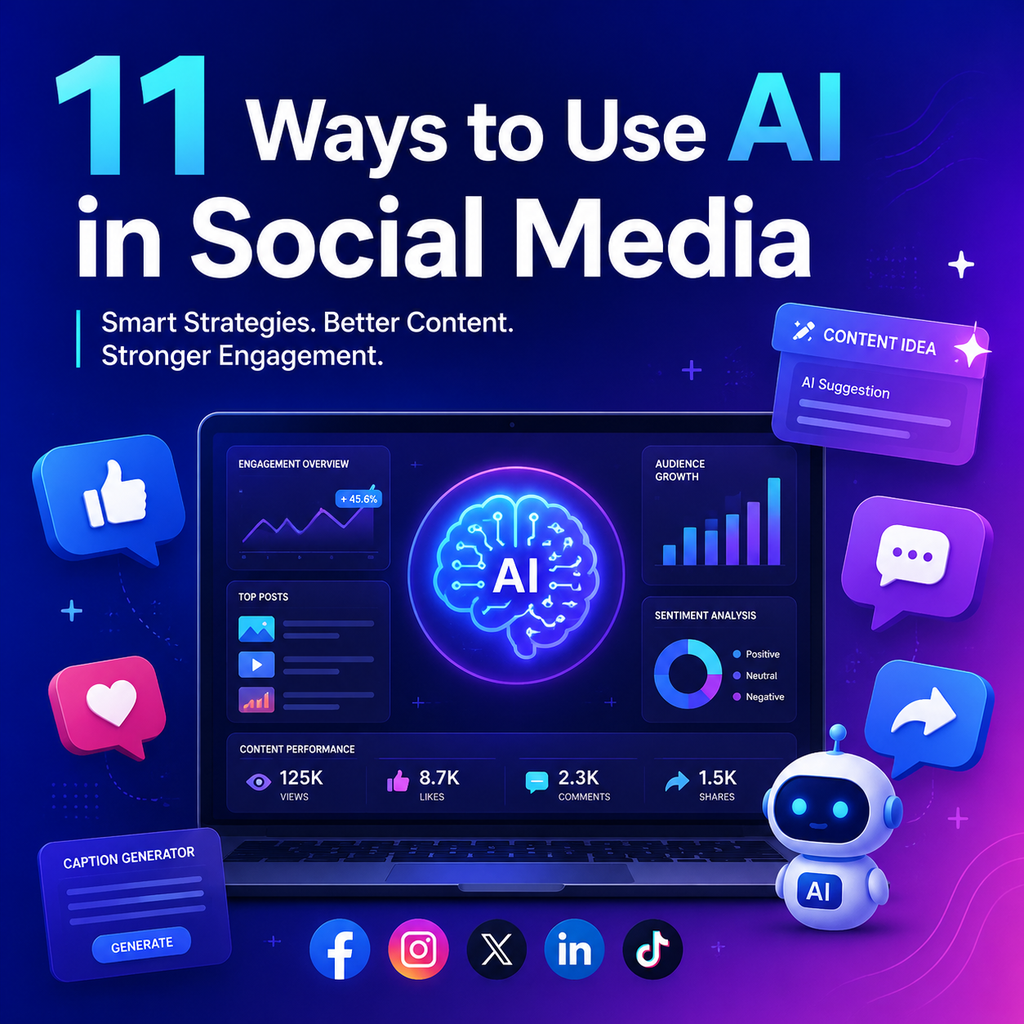
11 ways to use AI in social media (not just for content creation)
Analyze and summarize large data sets
AI is a powerful tool for sifting through mountains of social media data to uncover actionable insights. Instead of manually tracking comments, shares, and sentiment across multiple platforms, AI can quickly summarize patterns, flag emerging trends, and highlight what your audience cares about most. This saves hours of grunt work, letting you focus on strategy.
For example, you can feed your social media analytics into an AI tool like ChatGPT or a specialized platform and ask it to summarize top-performing posts, common audience questions, or sentiment shifts over time. This is especially useful for monthly reporting—AI can produce a concise, digestible summary of your social performance, complete with recommendations for next steps.
Analyze your industry niche and identify strategic gaps
Beyond your own data, AI can help you understand your competitive landscape. By processing information from competitor profiles, industry forums, and social conversations, AI tools can pinpoint gaps in your niche where your brand can stand out.
You can prompt an AI to compare your content strategy with competitors, identifying topics they cover heavily and areas they ignore. Often, these gaps become opportunities for your brand to lead the conversation. For instance, if your competitors focus only on product benefits but not on customer education, AI can suggest creating tutorials or FAQs that fill that void.
Train AI to understand your brand voice
To get the most accurate analysis, train your AI on samples of your brand’s best content. Provide it with examples of your tone, language, and messaging style. This ensures the insights and suggestions it generates feel authentic and on-brand, rather than generic.
Generate personalized content calendars
AI can help you plan weeks of content in minutes. By feeding your AI tools information about your audience, goals, and past performance, it can generate a tailored content calendar for each platform. You can ask for a mix of posts—single images, carousels, videos—and even request captions, hashtags, and image prompts.
A useful approach is to break your content plan into separate strategies for different formats. For example, request 30 single-image post ideas, then separately ask for carousel and Reel strategies. This prevents the AI from mixing formats and lets you dive deep into each type. The result is a ready-to-execute plan that aligns with your brand voice and business objectives.
Use AI for cross-platform optimization
What works on Instagram might flop on LinkedIn. Use AI to tailor your calendar for each platform. Provide context about the platform’s culture and your audience there, and the AI will adjust tone, format, and posting frequency accordingly.
Create compelling hooks and captions
Writing hooks that stop the scroll is a skill, but AI can accelerate your brainstorming. Give your AI a summary of your post content, target audience, and desired emotion, and ask for 10 hook variations. The AI will produce options ranging from curiosity gaps to bold statements, which you can then test or mix and match.
For captions, AI can help structure storytelling around your hooks. It can suggest question-based openings, micro-storytelling, or educational points. Remember to adjust the tone to match your brand—use your trained brand voice prompts to keep it from sounding robotic.
Generate and refine AI image prompts
Visual content is crucial, and AI tools like Midjourney or DALL·E can create custom images from text prompts. But crafting a good prompt is an art. Use AI itself to help you write detailed prompts: describe the scene, mood, colors, and style you want, and let the AI iterate on it.
For example, you can ask ChatGPT to generate 5 image prompts for a post about productivity tools, specifying a minimalist style and warm tones. It will return ready-to-use prompts that you can drop directly into an image generator, saving you time and ensuring consistency across your visuals.
Optimize posting times and frequency
AI can analyze your historical engagement data to determine the best times to post for maximum visibility. Tools like Sprout Social and Later use AI to suggest optimal posting windows based on when your audience is most active. This data-driven approach removes guesswork and increases the likelihood of your content being seen.
You can also use AI to experiment with frequency. By varying your posting schedule and having AI monitor the results, you can find the sweet spot between staying top-of-mind and overwhelming your followers. Some platforms even offer AI-powered scheduling that automatically adjusts your queue based on performance signals.
Monitor sentiment and detect crises early
AI-powered social listening tools can scan millions of conversations in real time, analyzing sentiment (positive, negative, neutral) and detecting sudden spikes in mentions. This allows you to respond to a brewing crisis before it escalates. For example, if negative mentions double in an hour, AI can alert your team to investigate and craft a response.
Beyond crisis detection, sentiment analysis helps you understand how your brand is perceived over time. You can track reactions to a new product launch or campaign and adjust your messaging accordingly. This continuous feedback loop keeps your social strategy agile and customer-centric.
Automate customer responses and social care
AI chatbots and automated response tools can handle common customer queries on social media, from business hours to product availability. This ensures your audience gets instant replies, even when your team is offline. Generative AI takes this further by personalizing responses based on the customer’s history and tone.
Set up AI to handle FAQs, direct message greetings, and comment replies with your brand voice. You can also use AI to escalate complex issues to human agents seamlessly. The result: faster response times, happier customers, and more time for your team to focus on high-value interactions.
Personalize content and ad targeting
AI excels at analyzing user behavior to deliver personalized content. On social platforms, AI algorithms already decide what content users see, but you can leverage AI on your end to create content variations tailored to different audience segments. For example, you can use AI to generate different versions of an ad copy for different demographics.
Predictive analytics tools can forecast which users are most likely to convert, helping you target your ad spend more efficiently. By feeding your CRM and social data into an AI model, you can identify lookalike audiences and optimize bidding strategies for better ROI.
Measure and report performance with AI insights
Finally, AI can supercharge your reporting. Instead of manually pulling numbers from different platforms, use AI to aggregate data, spot trends, and generate narrative summaries. Tools like Sprout Social and native insights dashboards now include AI features that explain what your data means, not just what it is.
Ask your AI to highlight the top three wins, the biggest opportunities, and the metrics that need attention each month. This transforms a standard report into a strategic document that informs decision-making across teams. AI-powered reporting also makes it easier to share insights with stakeholders who don’t have time to dig into spreadsheets.